
I Had Never Seen a Greener Desert
When we arrived in the south of the peninsula, Martín described the landscape with a memorable phrase: “I had never seen a greener desert.” Bittersweet situations marked our last week in Baja California Sur.

In the north, we had found very little vegetation. It was a world of sand and rocks, often monochromatic, but in the south the mountains dressed themselves in green. Although the desert still dominated the landscape, shrubs, low trees, and climbing plants grew among the cacti.


After two days of rain, we noticed a subtle change: white flowers appeared among the vegetation along the road. We stopped at a viewpoint where the richness and contrast of colors were impressive: the clear, cloudless blue sky, the emerald mountains, and the indigo sea. Climbing plants covered in white flowers spread over the shrubs, giving me the impression of snowflakes caught among the brambles.


As we began climbing into the mountains, a yellow butterfly crossed in front of us, followed by another, and another… and many more. They fluttered close, and the air pushed them upward before they could hit our windshield. Their flight brought joy to a world that, only days before, had seemed lifeless and had suddenly awakened from a long slumber. Just as I began to wonder where these delicate creatures would find nectar, the white flowers answered.
Then a multicolored garden appeared. First I saw the little yellow, bell-shaped flowers, then the pink vines. They grew along the edge of the road and on the rock walls. I wanted to see them up close, but the road was so narrow that I couldn’t stop.


When we reached an open area, we pulled over and found leaves on the shrubs that had barely begun to sprout and glowed fluorescent green. The climbing plants wound themselves around the cacti and trees and climbed over the rocks.
The green landscape continued like this until we reached La Paz, but I won’t dwell any further on the story of our immigration disaster.
Flying from Tijuana
The flight back from Tijuana allowed me to put into perspective everything I couldn’t see from below. The mountains in the north looked as if they were made of crumpled brown wrapping paper. I could also see how narrow the peninsula is: from my window, I could see the Sea of Cortez and its islands, while the Pacific Ocean gleamed above. Finally, we reached the south, with its green mountains and the sandy channels where rivers form after heavy rains.


The Crossing to the Mainland
From the moment we began planning the trip, the ferry crossing was one of the most crucial moments because it would let us travel the entire Baja California peninsula and then sail with the Atlas to Mazatlán on the mainland.
Although we thought we had all the documents necessary to board, there was one we didn’t know existed. When we were already at the port, they told us we had to drive forty-five minutes back to La Paz and go to the same immigration office where we had been detained. My blood ran cold. I imagined the worst and thought our situation would get tangled up all over again.


We went through this entire process under the blazing sun, while the employee helping us was inside an air-conditioned office. Every time she opened a small crack in the window to speak to me, I felt a blast of cold air on my face. She was a very young woman and was desperate because she didn’t want to help us. Maybe a wave of hot air came in every time she opened her window. But when she learned that we came from Florida, I was able to connect with her. Her dream was to visit Orlando and go to Disney World, and from that moment on, our conversation flowed, and we were able to access the website. After many attempts on the phone and on the computer, and after changing the form language to Spanish, we finally managed to print it when we were about to melt.

When they gave me the go-ahead, I went to customs, where they made me take out all my luggage and even asked for the purchase receipts for my cameras, which were already old. In the end, drenched in sweat, I packed everything again and drove the Atlas up to the ship’s fourth level. There I met up with the boys, who had been taken there by bus. Why did I have to handle all the immigration and customs procedures by myself? Because I had noticed that the authorities preferred to speak with me. They see me as the expedition’s leader. Ha, ha, ha


The twelve-hour journey began with a spectacular sunset. The ship was a mixture of a ferry and a cruise ship. We had live music and a meal so abundant that I couldn’t bring myself to try it when I saw how big the tray was. We slept in a tiny cabin with four beds, but it was very comfortable.


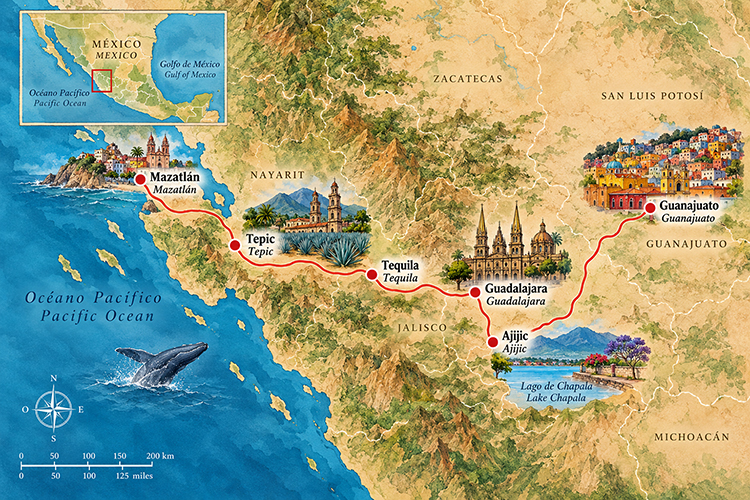
I got up early to see the sunrise, and although it wasn’t as bright as I had hoped, I saw it bathed in a gentle rain and pastel tones. Mazatlán welcomed us with heavy traffic, and there we began our route south. Four hours later, a blown tire cut it short.


Everyday Angels Across Mexico
Today I also want to pay tribute to all the loving people who have crossed our path during the brief two weeks we have traveled through their country.
Phrases people offer us with a smile on the street, in restaurants, and at the market, and that stand out and touch us because there are many places where they are no longer used:
—Good morning!
—Good evening!
—Enjoy your meal!
I especially want to thank everyone who has prepared and served our meals and has had the patience to explain the ingredients and the names we don’t know: pozole, cochinita pibil, mulas, sopes, burrote, vampiros, etc.


Many times I prefer to be in the kitchen rather than the dining room because there I can listen to the stories and understand this new and unfamiliar world. Angélica not only taught me her technique for making tortillas, but she also opened her heart to me. We shared our lives, our pain, and our experiences. We even laughed when I told her that the person who introduced me to chilaquiles was Cantinflas in a movie I saw as a child. With that, we sealed our connection. We both came from the same generation. Her mother taught her to make tortillas when she was eight, and she has made them every day since.
The Parking Lot Manager
In Cabo San Lucas, we looked for a café while we waited for the time to go to our apartment. It was in a small shopping center where almost every parking space had a sign with the supermarket’s name and, underneath: “15 minutes or it will be towed.” The tone was threatening, and we began backing out to look for another place.
Suddenly, an older man approached us and explained that he was the parking lot manager and guaranteed that nothing would happen to us. He said he had worked there for more than twenty years, and his job was to look after and clean the cars. With a rag and a bucket of water, he promised to wash the Atlas until it was “cleaner than the day we bought it.” And that is exactly what he did. He even managed to remove the collection of insects we had been carrying with us since we left Florida.
An Angel with Imperceptible Little Wings
This big, strong man arrived at a critical moment when one of the Atlas’s tires was punctured on the highway. We didn’t have the knowledge or technique to change it. First, we unloaded all the luggage and set it on a gravel clearing. Then we searched YouTube for instructions on how to change the tire.


While Martín and Cárter racked their brains over the tools, this man appeared at exactly the right moment. We were in a lonely place under a blazing sun, and he approached us and immediately offered his help. Once he had installed the spare, he tried to refuse fair payment for his work. Fortunately, he accepted it just as his bus stopped, then disappeared, leaving us amazed.
The Tepic Autopro Family


We stopped in Tepic to find a new tire for the Atlas. A Google search led us to a place called “Tepic Autopro,” where Juan Témoc, his wife, and their beautiful little dog, Tokio, took care of us.
The treatment we received was no ordinary sale. They welcomed us like family and gave us space to unload all our luggage, an air-conditioned waiting room, and many stories to share. At the end of the afternoon, we said goodbye with a big hug as if we had known each other all our lives.
Our Four-Legged Friends
Today I also want to mention all those furry friends who make us smile every day.

After living in the United States for so many years, I had forgotten what it felt like to encounter them on the street. Here in Mexico, as in many Latin American countries, street dogs are still an everyday reality. They go out in packs and have the good fortune of having friends with whom to share their games, mischief, and, above all, their freedom. In the desert, I saw them walking peacefully near the towns. They jumped and ran together, stopped and perhaps discussed what step to take next, then continued with their ears up and their tails wagging.

Last night we went out to see the colonial town of Tequila, and a beautiful little dog came along with us. Cárter fell in love with her, or perhaps it was mutual love at first sight. After a few mutual hugs and licks, Cárter decided to go into a store to buy her some ham. He assumed that because she was on the street, her cuddles and affection were because she was hungry. But she pretended not to notice and wouldn’t take it.
She continued walking proudly ahead of us, glancing back out of the corner of her eye to make sure we didn’t make an unexpected turn and disappear from her sight.
She wasn’t looking for food. She just wanted to accompany us and make sure we were safe on her streets. That was how she said goodbye to us that night, reminding us that in this country, hospitality also comes on four legs.
She wasn’t looking for food. She just wanted to accompany us and make sure we were safe on her streets. That was how she said goodbye to us that night, reminding us that in this country, hospitality also comes on four legs.
Our Route

Our 945 miles journey from Tijuana to La Paz, and from there, the 12-hour crossing to Mazatlán.

Comments