
Detained by Immigration Police
When we were stopped by immigration police, the lack of a passport stamp put our safety and our trip to Patagonia at risk.

This special edition is a response I don’t want to delay, both to thank you for your messages and to reassure you that we are all right.
I am starting to write this story from the plane that will take us back to Baja California Sur, where the Atlas, our home on wheels, is waiting for us.
But what happened?
In my last story, I shared the anxiety I felt while crossing the land border in Tijuana. If you haven’t read it, you can find the story here:
Maybe I should have listened to that little voice that was making me feel uneasy, but I had gone over my endless checklist so many times that it never occurred to me that, after crossing the border, I would have to find an immigration office outside the crossing to get my passport stamped.
My list included medical appointments and international health insurance, insurance for the Atlas, replacing brakes and tires, canceling subscriptions, finding new options for our cell phones without losing our numbers, getting passports, and taking care of everything I still had pending in the United States after living in this country for 25 years.
I let my guard down because we had crossed the Canadian border several times during the previous months, and our passports had never been stamped because all the documentation is online. I assumed that if there were no immigration booths to stamp our passports, it was because they didn’t need stamping. It never occurred to me that it was my responsibility to find a place to have it done.
Irregular or illegal?
I only found information about this crossing for travelers after this incident, and only because I searched for it knowing what answer I was looking for. It never crossed my mind that I would be someone with “irregular” status, the term Mexican immigration officers use and the one I prefer, because the word “illegal” sends shivers down my spine.
The day we crossed, we drove past dozens of security cameras flashing left and right, which made me feel that we had already been completely identified and that the actual immigration process would happen before we reached the mainland. Over the next few days, we were stopped at many checkpoints and, although we had our passports in hand, no one ever checked them.
In fact, everyone was so kind and respectful that we gradually relaxed and began to think that the Mexican police had a bad reputation. They always wanted to hear our accents and were curious about our journey. So we weren’t worried when we reached the last checkpoint, although this time they did ask for our passports.
“And the Stamp?”
—The officer asked.
We looked at each other, surprised. We had no idea what stamp he meant. Then they asked me whether the boys had a Mexican father, trying to figure out whether there was some way to resolve the mess other than deporting us.
We explained, honestly and rather naively, exactly how we had crossed the border, and that’s when we learned our case was not unusual. They receive several “irregular” travelers every day. They even have an employee whose sole job is to collect and escort them.
I asked the officer why they didn’t try to prevent this by setting up immigration booths and posting information at the border. They agreed with me because they knew the way that border crossing worked was absurd, but governments don’t work that way.
Time passed, and we still didn’t know what our situation was.
We waited under a cloud of mosquitoes and a scorching sun, with temperatures nearing 40 degrees. Later, we were asked to bring the Atlas over near the offices, and only then did I realize this wasn’t a temporary issue that could be resolved with a simple bit of paperwork.

The guys took out their instruments to relieve the stress, while I tried to get a bit more information.
Were we being detained? Were they going to deport us? What would happen to the Atlas, to all our things?
The officer stood us one by one against the wall of the checkpoint booth and photographed us up close and full length. Things were beginning to feel more serious. After the shift changed, they took us away in a van and seated us behind the metal partition separating the cab from the back.
It felt like a movie, and we still couldn’t tell whether it would have a happy ending or a tragic one.
The Bingo Game
At that moment, Cárter reminded Martín about the bingo game they’d created. In each square of the board, they had written possible scenarios they might encounter during this trip, both good and bad.
Cárter had “getting arrested” on his list.
Martín had written, “problems at a border.”
They both scored points that day, and we couldn’t stop laughing, perhaps because laughter was the only thing keeping us from giving in to pessimism or fear. This photo comes from that moment.

Then they told us they were taking us to forensic medicine for a “medical examination,” which increased our anxiety. As we made our way through the slow traffic of La Paz, I was texting my children in real time, and of course they became worried. I wanted to make sure that if we disappeared, they’d at least have some clue about what had happened to us.
We arrived at the Comandancia de Peritaje, a gray, gloomy building with unfinished concrete floors and no furniture. The driver and the officer escorted us into the waiting room, a very narrow space of about two by three meters, with two wooden doors and an opening where a third door might have been, crossed with the kind of yellow police tape they use to seal crime scenes in movies.
One wall had a couple of deep holes that made me think someone had punched through the drywall. The only piece of furniture was a broken office chair with casters, used to prop open the doctor’s door. On it was a sign printed on worn paper that read: “Forensic Doctor.” On the other door, a similar sign read: “Biometrics. Photography prohibited.”
And I, a photographer, didn’t want to miss a single detail. Although I was dying to document everything, I restrained myself. I didn’t want them to take away my phone or get myself into even more trouble.
The officer had warned us that we would go in one at a time and prepared us to answer questions about our health, whether we used drugs, whether we had any illnesses or took prescription medications. Then they would take our fingerprints.
Meanwhile, my daughter texted me to ask whether they were going to vaccinate us, and Cárter said he had his vaccination records.
None of that happened.
From his desk, the doctor asked us to confirm that we had no injuries. We said we didn’t. He signed our paperwork, and we walked out without ever having seen his face.
They escorted us back to the van.
Our Biggest Fears: Jail and/or Deportation
From the Forensic Medicine building, they took us to the Instituto de Migración. There, we entered an office where about eight uniformed officials received us kindly and told us we were in an “irregular” situation. They read us our rights and handed us a stack of documents to sign confirming that we had been treated according to procedure. We had to sign eleven pages and provide our fingerprints.
Once the procedure was over, they gave us ten days to leave the country voluntarily. If we failed to do so, we would be deported, with all the legal consequences that entailed. Finally, they photographed us to confirm that we were leaving in one piece and without a scratch.
Sometimes I think my white hair helped us receive more respectful and compassionate treatment.
Despite how kind they had been, the news hit us like a bucket of ice water. As I processed the information and considered our options, those ten days seemed far too short.
We were twenty hours from Tijuana, which meant about forty hours of driving there and back. It had taken us an entire week to make the journey south, and we would need another two weeks to go back. And what if they didn’t allow the car back into Mexico, or didn’t allow us back in ourselves?
It had been a beautiful journey, but now we wouldn’t be doing it for pleasure. We would be driving out of necessity, arriving exhausted at an uncertain destination.
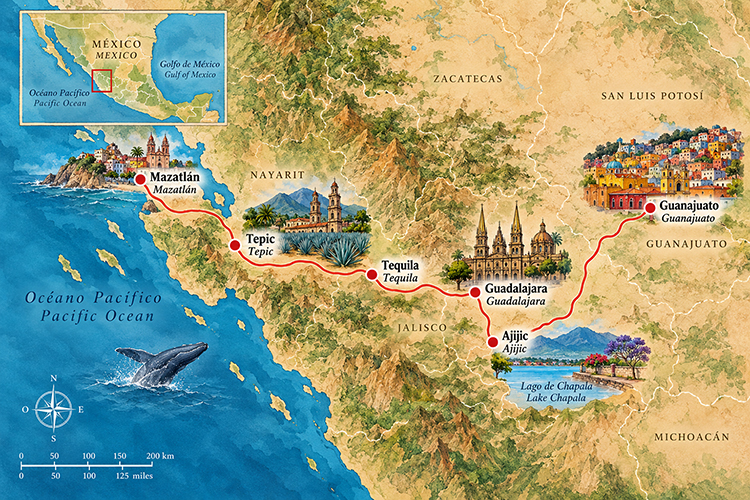
The second option was to urgently complete the paperwork for the Atlas’s temporary import permit so we could put it on the ferry, take the twelve-hour ferry to Mazatlán, spend a day on maintenance because the Atlas’s computer had already told us it was due, and then drive another twenty-eight hours to the Guatemalan border.
We would have to endure exhausting driving days, without even accounting for traffic or unexpected problems. The advantage of this option was that even if we weren’t allowed back into Mexico, we could continue south without abandoning the journey. But I didn’t think it was viable. It would be a race against the clock, and if anything went wrong on the road, we could end up being deported.
A third option was to leave the Atlas in a parking lot in Baja California Sur and fly to Tijuana. Cross the border into the United States on foot. Then return to the Mexican border and, from inside the airport, go through the regular immigration booths and have our passports stamped as we entered Mexico “legally.”
In theory, it sounded possible, but it was also very expensive and would disrupt our budget. And there were risks. What if the immigration officer wouldn’t let us enter because of our “record”? Where would we leave the Atlas with all our belongings? How long would we have to stay outside the country?
The thought of being separated from my things, leaving them miles away without knowing whether I would ever see them again, sent shivers down my spine: my cameras, my hard drives containing the files from my entire career, and my original watercolors.
Those were all my possessions, because I don’t have a house.
When we finally left the immigration offices, still confused, a police driver took us in an unmarked car to pick up our Atlas.
That night, I couldn’t sleep because of the anxiety.
We Chose the Third Option.
We drove to the airport in Los Cabos, two hours away, flew to Tijuana, and walked through seemingly endless airport corridors until we crossed the border into the United States. We went through U.S. immigration in San Diego and stepped outside.


Now came the part that worried us most: getting back into Mexico.
We entered the same airport again, but through a different entrance, to go through Mexican immigration and get our passports stamped.
The immigration officer who helped us was very kind, and she had no idea how much emotion we felt with every click of the stamp.

We went to a hotel because it was already very late, and I sat down to publish my story for the week on my personal blog and Substack.
The next morning, we flew two hours back to pick up our Atlas, with everything inside exactly as we had left it.

Comments